Game fish · trout and salmon family
Brown trout
Salmo trutta
Native to Europe and western Asia; introduced to Ontario streams in 1913.
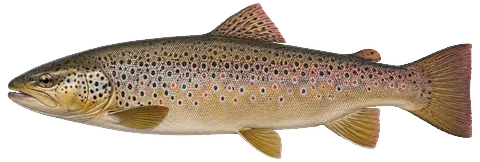
- Typical adult
- 20–60 cm (8–24 in), about 0.5–4.5 kg (1–9.5 lb)
- Lives
- Commonly 5–12 years
- Spawns
- October to November, over gravel in streams, at 6–9 °C (43–48 °F)
- Eats
- Invertebrates and small fish; feeds most at night
- Needs
- Cool water; prefers 15–18 °C (59–64 °F)
Where brown trout have been recorded
38 of the 1,347 Ontario lakes on this site with angler catch reports list brown trout, across 13 counties and districts. Tap a dot to open that lake’s depth map.
Recorded here Other lakes with catch reports
How we know
- 38lakes where an angler logged one in Fish ON-Line; on 27 of them a single trip, one angler’s report
Self-reported by anglers, not a Ministry survey. A lake that isn’t listed may still have them: a lake appears here only once an angler has logged this fish there.
Brown trout are one of the species raised in Ontario's fish culture stations and stocked into provincial waters.
Inland lakes on this list run from 7 to 183,191 acres (median 120) and from 10 to 292 ft deep (median 54.5 ft).
When and how anglers catch brown trout
From 76 trip reports naming brown trout on the lakes above, logged by anglers in Ontario’s Fish ON-Line app. These are self-reported trips, not a Ministry survey: they show when and how people fish for them, not how many fish a lake holds.
Trips by month
The busiest month is May (14% of trips); 36% were logged December–February (lighter bars).
How they were fishing
Share of the 76 trips that recorded boat, shore or ice.
Fish reported
215 brown trout reported on these trips. Anglers kept 34% of the ones they reported and released the rest. The app records no sizes.
Lakes on this site with the most trips
- Alaska's Lake, Sudbury District 20
- Loon Lake, Sudbury District 5
- Darling Long Lake, Lanark 4
- Dowes Lake, Sudbury District 3
- Grand River section, Waterloo Region 3
- Johnson Lake, Sudbury District 3
- McLeod Lake, Thunder Bay District 3
- Belanger Lake, Renfrew 2
- Niger Lake, Haliburton 2
- Turkey Lake, Algoma District 2
Trips that logged this fish on each lake. A busy lake gets more trips; this is not a ranking of fishing quality. 27 of the 38 lakes are listed on a single trip, one angler’s report.
Often found with
Share of these lakes that also list each fish.
How to recognize it
A brown back with silvery or pale brown sides carrying dark spots, often ringed in a lighter colour, and only a few faint spots on the tail. It is the only Ontario trout or salmon with orange on the small adipose fin between the back fin and the tail.
Don’t confuse it with
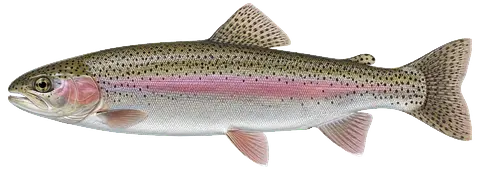

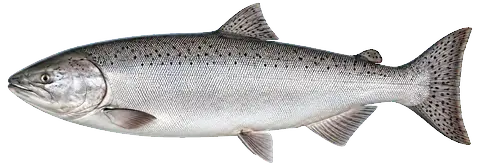
Life in an Ontario lake
Brown trout come from Europe and western Asia and were first released into Ontario streams in 1913. They now live throughout the Great Lakes and their tributaries and in streams across southern Ontario, and are most plentiful in Lake Ontario, Georgian Bay, Great Lakes tributaries and stocked inland creeks. Great Lakes fish grow larger than inland ones and can have a blue-green back with smaller spots.
They favour cool creeks and rivers with gravel riffles and pools, as well as lake shallows, and in the Great Lakes they tend to hold in shallower water than rainbow trout or Chinook salmon. They feed hardest at night. In the fall, Great Lakes fish move into tributaries, where they spawn over gravel from October to November.
Source: the sources below.
Rules and eating
Before fishing, check the current Ontario Fishing Regulations Summary for your Fisheries Management Zone, any exceptions for the waterbody, and your licence type. Angler catch reports show what people logged, not what is legal to catch or keep. Fish ON-Line itself (how to use it) maps the zones and exceptions. Before eating fish from a particular lake, check the Guide to Eating Ontario Fish.
All 38 lakes with brown trout
Show every lake, by county
Algoma District 6
Bass Lake, Belanger Lake, Elliot L., Granary Lake, Spur Lake, Turkey Lake
Cochrane District 1
Frontenac County 2
Haliburton County 9
Basshaunt Lake, Blackcat Lake, Canning Lake, Drag Lake, East Jeannie Lakes, Glamor Lake, Kennisis Lake, Minden Lake, Niger Lake
Hastings County 1
Lanark County 3
London 1
Muskoka 1
Renfrew County 3
Sudbury District 7
Alaska's Lake, Broder Lake 23, Cecile Lake, Dowes Lake, Johnson Lake, Loon Lake, Whitefish River
Thunder Bay District 2
Waterloo Region 1
York Region 1
Sources
- Government of Ontario: Brown Trout
- Ontario Freshwater Fishes Life History Database: Brown Trout
- Government of Ontario: Ontario's fish stocking program
- Ontario Ministry of Natural Resources, Fish ON-Line — the angler catch reports behind the lake list, map and trip figures. Contains information licensed under the Open Government Licence – Ontario. The data holds no angler identities.